The 3 R’s of the Trust Formula – R#1
Peter Brissette • March 30, 2018

Hello, Peter Brissette here, Digital Marketing Dude. I’m putting together a series of videos on what I call the Trust Formula. This Trust Formula can really work for a local business and it can work for almost any type of business. It really works whether it’s a business that’s a mix of online digital or if it’s offline, and parts of your business are offline as well. That’s really typical for most businesses, there’s some mix. There’s the online and the offline and how you mix those together.
I want to talk about the Three R’s of the Trust Formula and I’m going to share my screen with you here in a second, we’re going to start to break these down over the next series of videos. The one thing I want to take to you about first is kind of a key principle that’s a basic foundation that we have to remember and make sure that we’re understanding where it fits in the mix. That has to do with what you own and what you rent. This is really specific to your digital assets, your digital properties. What do you own and what do you rent?
Let me see if I can explain: For your website you own that. Now, you might have it hosted on another company but that’s your website. You own it. You control the content. You control the information that is there. You own that. That’s your property. Your Facebook page, your business Facebook page. Do you own that? Technically no. Technically Facebook owns it, they’re letting you rent it. Okay? They’re letting you use that Facebook page and be on their platform to do marketing of your business. At any point in time Facebook could take away that access. They could shut you down and not allow you to market anymore on their platform.
That’s a couple of basic examples. The other thing that you own that you own that so many businesses that I talk to, and I consult with dozens of businesses every few months, and I find it as a common thread. They don’t own and don’t have a really good email list. Excuse me. I’m leaving that in. They don’t own their email list and they don’t have real control of their contacts, their customers, their past clients, their database. That is one of the key most important assets that you do own, that you have control of and you have to keep it in a really good system that’s easy to use, easy to track your contacts and easy to create follow up systems that you can stay in touch with them.
The two main properties that you own are your website and your email list. Just remember that as key principles of this overall of the Three R’s of the Trust Formula. Now, I’m going to share my screen with you and we’re going to dig into the first R of the Trust Formula. Again, we’re going to keep this out here as this reminder of our owned versus rented properties. That’s really your website and your email list. That’s what you own. The things that you rent are your social media profiles; Facebook, LinkedIn, and maybe some other various marketing tools. I am just going to put that right there so that’s part of our set up here.
Now, the first R that we’re going to talk about is reviews. Actually let me go in here. There’s a few key aspects for reviews that we’ll talk in this video and the next video’s coming up we’ll get into the other R’s. When it comes to reviews, a couple things to remember, these are super important. People trust more about what others say about you than what you say about yourself. This is really critical to build trust quickly with someone who doesn’t
even know who you are, maybe that’s never heard of you, maybe wasn’t a referral. They’re just coldly looking at who you are. Your online reviews and what people say about you is super critically important.
How do you get more reviews? How do you get better reviews? The first thing you have to do is make it easy for them. You must have some basic system that makes it easy for people to leave you a review. That’s something that we offer as a tool and a service, so regardless if you use our tool, someone else’s tool, or you just come up with a way to make that easy for them, you have to make it easy.
The reason for that is that when there’s a negative thing that happens, I’m really highly motivated. I can’t wait to go and say something about you negatively. I’m very highly motivated. When I’m really happy with the service that I got, I might be really happy with it but I’m not necessarily as motivated to go express that somewhere in a review online or send you an email, a testimonial. Now, it can happen but it’s just not as a strong a motivation.
That’s why you got to make it easy and then you got to do step two, which is you must ask for them. You have to ask for reviews. You just do. Because there is such a pent up reviews sitting there just waiting to be given, if it was easy and someone asked them they would do it. That’s why you need to do those two things. Finally, I’m not going to share on this video but there are six key questions for amazing testimonials. It’s from a guy named Sean D’Souza that came up with this, out in New Zealand who’s brilliant. We’ve used this for creating some of our key testimonials. If you sell a very high dollar service or product, if you really need to build a high level of trust to really connect to your audience on a much stronger level, then you need to take the next step and do the six key questions for amazing testimonials.
A couple key principles with that is that you need to schedule time with that person to sit down with them and go, “Here’s the questions. Please go through these and answer these.” Give them a way to type it up or write it up right there. It could be a phone interview or a Zoom web meeting, something like that. You want to have that individual actually set some time aside and make an appointment with them because this is really going to be critical to the kind of testimonials that you can have that you can share on your primary properties; your website or via email, or even on the rented properties that you have out there.
That’s the six questions. If you want the six questions, please message me on this post or on Facebook or wherever you see this, and let me know. We’ll shoot you an email with that. In fact, you can just email me if you want: [email protected]. That’s [email protected]. Just put subject line: six questions for amazing testimonials and I’ll send that back to you so that you have that.
That’s number one of the Three R’s of the Trust Formula and we’ll be working on R number two and R number three here in the coming weeks so that you can review those and get some help for your marketing for your business. Thanks for joining me on this video. I hope you got a lot out of it and if you have thoughts, questions, comments, please leave them below.
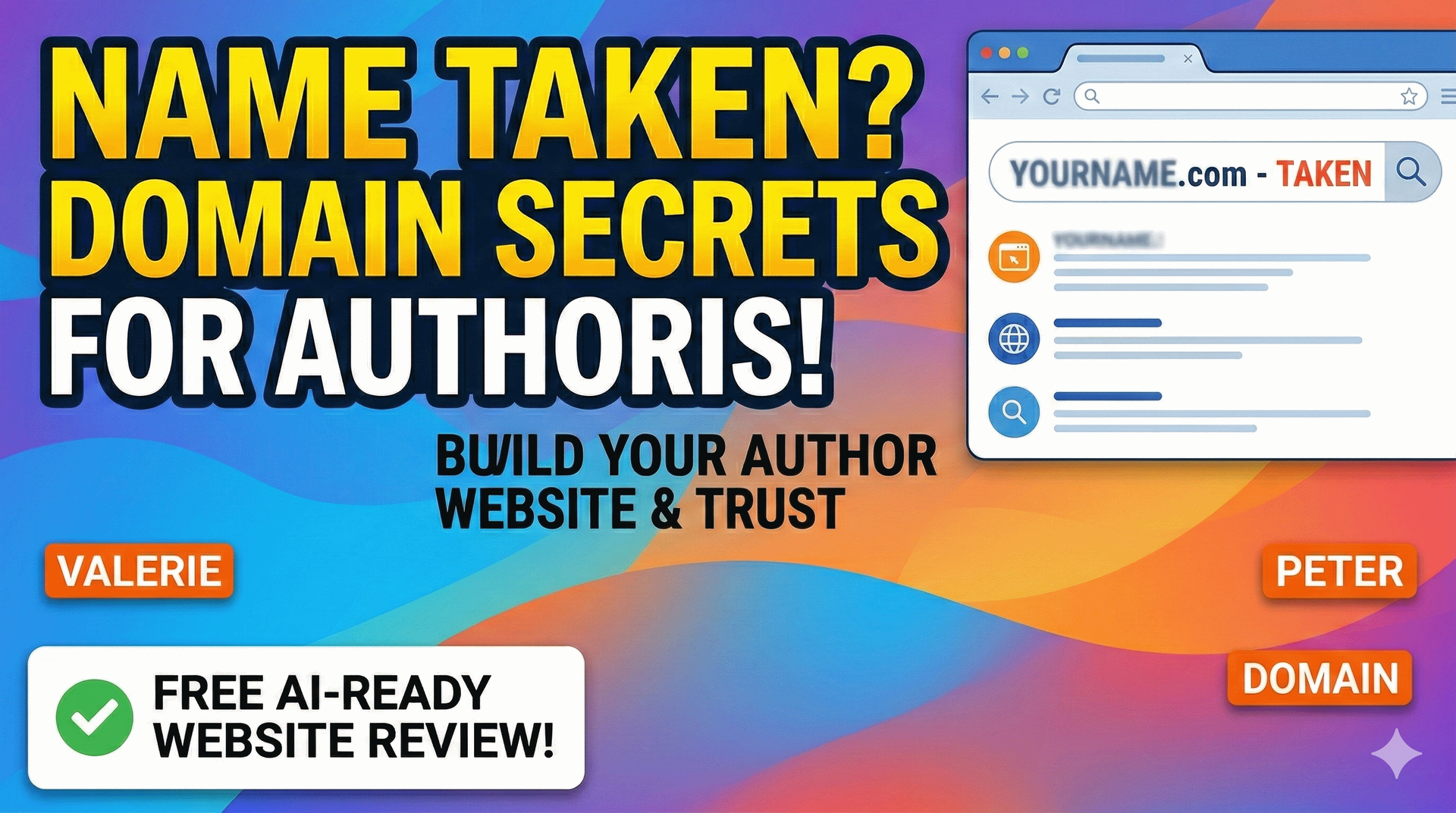
Stop Losing Your Readers Before They Even Find You: The Domain Dilemma You’ve spent months—maybe years—pouring your heart into a manuscript. You’re ready to share your voice with the world, but there’s a massive roadblock standing in your way: Your own name. Many authors realize too late that building a personal brand website is an urgent priority, only to find that their digital "home" is already occupied. The Frustration of Being "Taken" It’s a common, sinking feeling. You go to buy YourName.com and discover a famous person, a squatter, or even just another "John Smith" got there first. If you can't own your name, how are readers supposed to find you? Are you forced to use a clunky, forgettable URL that looks unprofessional? Without a clear, memorable domain, you aren’t just losing clicks; you’re losing the trust of your potential audience before they even read your first chapter. The Simple Fix for "Occupied" Names The good news? Your domain isn't "life or death"—it’s a tool. If your primary name is taken, you can still build a powerful, searchable brand by using modifiers . Add a Middle Initial: A simple JohnQSmith.com is often enough to differentiate you. Use a Brand Modifier: Terms like "Official" or "The" (e.g., TheJohnSmith.com) are easy for readers to remember and don't hurt your searchability. Focus on Content Over the URL: Google prioritizes the relevance of your content. Even if your domain includes a modifier, you will still show up in searches for your name if your website is built correctly. From Traffic to Trust We understand how overwhelming the technical side of authorship can be. You want to write, not troubleshoot SEO and domain redirects. But the bridge between a casual visitor and a loyal reader is Trust . When your messaging is clear and your website is optimized for modern search, you stop shouting into the void and start converting visitors into fans. By taking control of your platform early, you ensure that when someone searches for your voice, yours is the one they hear. Is Your Website Truly Ready for Readers? Don't let a confusing domain or a "leaky" website stall your career. I’m offering a Free AI-Ready Website Review to help you move from traffic to trust. Our expert team will provide: A custom-crafted headline designed for conversions. An AI-Readiness and Authority (E-A-T) check . Your personal Trust Potential Score . A personal video walkthrough with actionable improvements. This isn't a generic automated report—it’s a deep dive based on years of expertise. Claim your free review today at FreeWebReview.com .
Hey there everybody, Peter Brissette, Digital Marketing Dude. I want to give you an update this month on email and website security, kind of a combination there. One of the things that we’ve noticed over the years is whenever you put an actual email address listed on a website, it usually just gets scraped by spam bots and AI now. And then that email gets used to send you spam. A lot of it can be fairly innocent, but in some cases, you can get a situation like this. Clients started to send me this email that they were getting, and it comes from [email protected] First sign, it’s probably not from us. We send from our dmdude.com email. But they start talking about support and due to one of the vendors that we use for some of our services, which our clients, you know, they don’t know that. So it’s kind of like, what is that? We always do a full SEO setup from the very beginning for all our clients as well, so it’s already been done. There’s nothing else to do anyway. Where they got this email and this information was basically just from the website itself. So we really highly recommend that folks use a form on the website versus just having your email address just sitting on the website, because it can get scraped and used for purposes like that. So we recommend, you know, have a contact form. Contact forms can get spam as well. And so we use, you know, Google’s got a tool for CAPTCHA to help limit the spam that can come in using CAPTCHA. So I’ve got a calendar there to book with, but I also have this basic contact form. It uses the CAPTCHA from Google to help prevent spam from coming in. It still does happen. It doesn’t prevent all of it, but it prevents the majority of it. But if you go through my website, you’re not going to see anywhere where it lists an email address, “Contact us at this email address.” So we recommend just using a form. For our clients, we’re just going to start changing that out and making those changes over time. And then the other thing where we get a lot of spam from as business owners, if you have a business email account, there’s this platform called Apollo that allows marketers to buy access to email lists. So what we recommend, and I’ll put this link in the blog post, is that you go to this link here where it says “Don’t sell my info,” and you can opt out your email address from being in their database. And that will help cut down on the number of spam emails that you might get from that. So to recap, this video is about your email address being actually on your website where it’s visible, or even if it’s a link there that says “click here to email” and then it opens up the email. We don’t recommend that either. We recommend that you use just a form on your website and not have your email address just listed on the website, because AI bots and other tools can scrape that off your website. You wind up in a database like this, and you wind up getting a lot more spam. And it can actually lead to things like this where you’re actually getting fraudulent emails, people trying to actually scam you out of money. So if you have questions about this, just put it in the comments where you see this, and I’m happy to take a look at your own website and make sure that you’ve got the right things in place for email security. Here is the link to Opt Out of Apollo Email Database - Click Here to Opt Out
Video Transcript: All right, hey guys, Peter Brissette here, Digital Marketing Dude, and I wanted to share with you something new about Google reviews that you want to be aware of. So Google now will allow users to update their profile, their name on their profiles, so they can be more anonymous. So they're not entirely anonymous, but if they want to use an initial on their last name or shorten their first name, you know, if it's Jennifer and they just want to put Jen or whatever, Dogmom1234. They can change that on their reviews. So that change here just recently was updated means a couple of things. I just wanted to go through this article real quick and talk about that. So what exactly changed in the review system? So Google now allows any user to set up custom display name and profile image, which will appear on all reviews, photos, videos, and contributions across maps and search. It's also retroactive to all the other reviews that they have left as well. So you don't need to have a different Google account to protect your identity. You can just update your profile information. So in practice, what this should mean is that customers can leave reviews under a nickname instead of their full name. All past, future Google Maps contributions, adopt the pseudonym, applies across Q&A, images, and videos. So Google still knows the account behind the review, only the public name is going to be different. So it should allow, in some industries, folks to be able to leave reviews where maybe in the past they haven't. For example, legal services. So in legal services, can you imagine if you were charged for a crime and your attorney helped you and kept you out of jail or whatever it was, and you went on to post, hey, I got charged with shoplifting. And thankfully, my attorney helped me out. You may not want to put your name on that and have it out there. So things like that, mental health is another big area, various medical or health care practices, a lot of health care practices, I think this could affect. Definitely addiction treatment and recovery, financial advisors, and some sensitive home services. The big question is, does this is, The Increase fake review risk. Most people don't think so. Again, this article is from taprocard.com. They certainly don't think so because it's still a real account. It's not like it's a fake account or something like that. So I think it's still going to produce good reviews, but it should increase the number of reviews. And that's really why this matters for business. You should be able to get more reviews. What you want is more frequent reviews, more recent reviews, and that will help build trust from potential customers. And even with all the AI hype and everything that's going on, it's going to help you with your SEO in maps and search, in particular from phones. So how do businesses adjust the review request strategy? How One thing that can be added when you're requesting reviews is to mention if you'd like extra privacy, Google now allows you to leave reviews under a custom display name. And so that can be something that you add in there. I'm also going to put a link here in the post on how to change your Google display name so that you can see that and be able to offer that for your clients as well. So I just wanted to throw out this quick little update. If you have any questions about this, I want to talk about how your reviews are being managed right now. If you're using our services or someone else and would like to talk about that, please reach out. Thank you again, Peter Brissette, Digital Marketing Dude. Visit our website at dmdude.com. Here is the link to the original Post: https://taprocard.com/blogs/article/google-anonymous-reviews-update-2025 Here is a link that explains how to change your display name on google. https://support.google.com/maps/answer/15294714?hl=en
Facebook Profiles vs. Professional Mode vs. Business Pages: What’s Best for You and Why It Matters
If you're trying to figure out how to make your website more visible on Google, you're not alone. One of the most common questions small business owners ask is: “What should I do to actually get found online?”
How to setup a lead magnet to capture emails on Wix Website with Mailchimp from the best in website design in Westminster, CO
Learn the many benefits of a strong learning system on the backend of a speaking, coaching, consulting business.

Read our latest blog post on Mastering the Marketing A’s: Understanding Your Audience for Better Results.
The last question that should we follow our competitors on social media? Sure, why not. You know, you want to see what they're doing and see what's happening there. You know if you're going to be active and you're really trying to use social to build your business then having a good idea what's what your competition is up to is probably important. And you know sometimes what I find with so called competitors is that we you know often times find people that we can collaborate with. It doesn't necessarily mean they are competitors so we work with a number of other marketing agencies and provides some services for them for their clients that they don't necessarily do, but they hire us to do it for them. So like I work with other marketing agencies, so they're not necessarily, you know, your competitor and everything. So but yeah, see what's going on you know, investigate, read up on them, see what they're doing, check out their websites, see what they're ranking for. You know, the more you understand the competitive landscape, the more you know what you should be doing and what you need to do.
And the last question that we have is, can you say more about running a test on TikTok yeah, I so I'm not on TikTok I'm not using tiktok. I wind up watching a lot of TikTok videos on Facebook and the Facebook reels. I think it's fascinating. I find it very interesting. But it's not a platform that I've taken the time to jump on at this point. Again, based on where I'm at with strategy and so forth, it's not a fit for me. But anytime you're using any platform, if you're going to do something, you want to come up with some means of measurement. How am I going to measure success? What does success look like? Is it I, you know, posted a video and I got a thousand views. Is that success you know or is it actually driving traffic and are you tracking how much traffic and then are you tracking what happened to that traffic? Did they fill out a form, did they make a phone call? Like what's the, where do you want that to go? So we really need to step back and think about that whole process. Of creating content, I'm pushing this through to, you know, to my website. And this is what I want to have happen. This is what I wanted the results to be. And then how am I going to track it? How am I going to measure it and do that so anytime you're spending, anytime you're doing something new in particular. Or you're spending any money you need to track it all the way through. All the way through.